
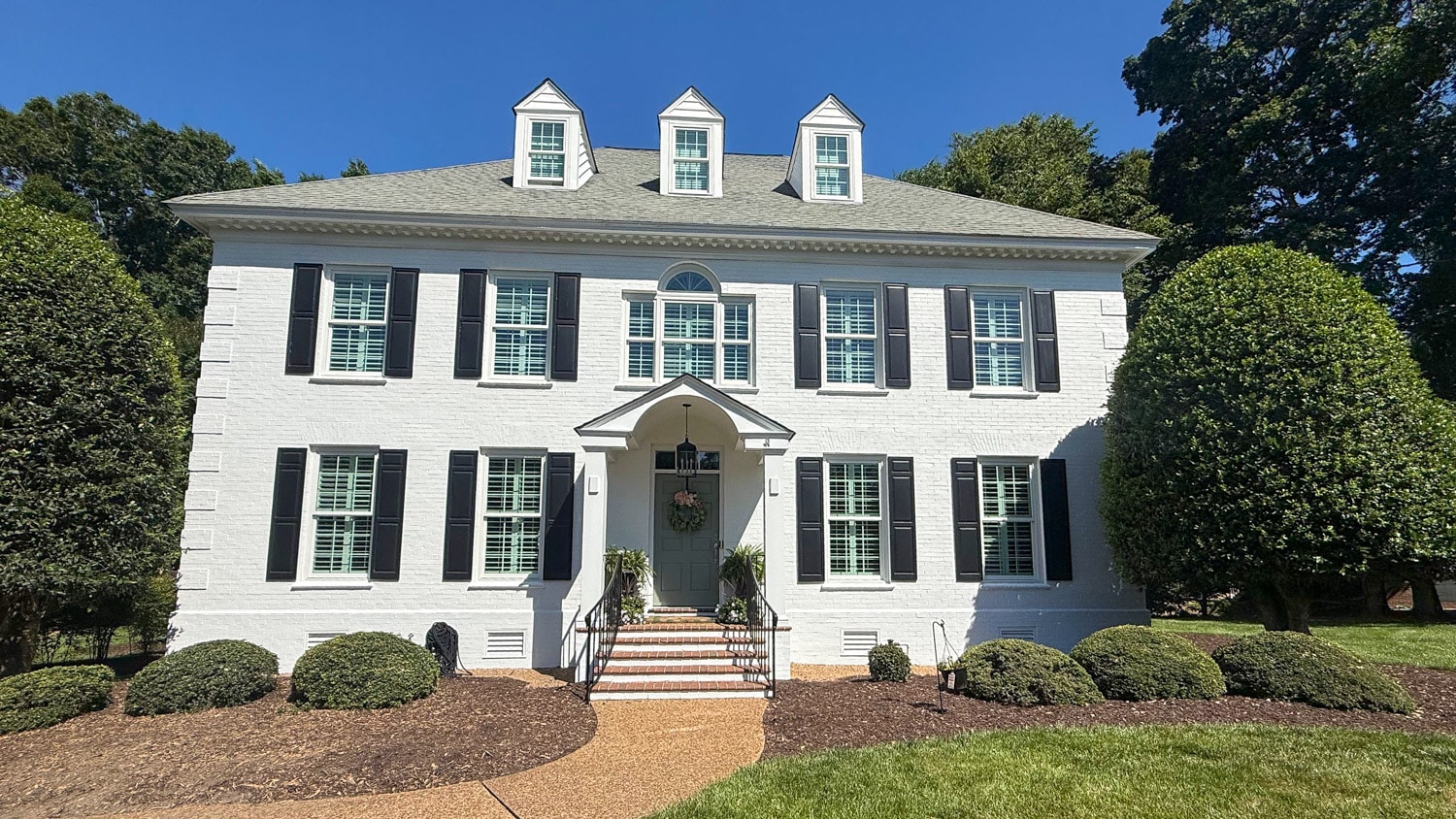
If your siding is starting to look chalky or your trim is showing bare wood, you are probably wondering how long does exterior house paint last before it needs to be redone. In Williamsburg, the honest answer is usually 7 to 12 years, and where your home falls in that range depends less on the paint can than on what happened before the first coat went on.
We have been painting homes in Williamsburg and James City County for over twenty years. In that time we have seen brand new premium paint fail in four years on a poorly prepped south-facing wall, and we have seen a careful job on a colonial in the Historic Area still look sharp at year fourteen. Below is what actually drives that difference, based on what our crews see on ladders every week.
Key Takeaways
- Most exterior paint jobs in the Williamsburg area last 7 to 12 years, with fiber cement and vinyl on the longer end and older wood siding on the shorter end.
- Coastal Virginia humidity, heavy spring pollen, and strong summer UV are the three biggest local causes of early paint failure.
- Surface preparation accounts for more of a paint job’s lifespan than the brand of paint you choose.
- South and west-facing walls almost always fail first, sometimes years before the rest of the house.
- Washing your siding once a year and recaulking as needed can add several years to a paint job.
- Chalking, peeling, exposed caulk gaps, and fading are the four signs it is time to repaint.
- Late spring and early fall are the best painting windows in this part of Virginia.
Table of Contents
- How Long Does Exterior House Paint Last on Average?
- Lifespan by Siding and Surface Type
- Why Williamsburg’s Climate Shortens Paint Life
- Why Preparation Matters More Than the Paint
- Signs It Is Time to Repaint
- Common Mistakes That Cut Paint Life Short
- Choosing Paint and Sheen for Coastal Virginia
- Maintenance That Adds Years to Your Paint
- What Exterior Painting Costs in the Williamsburg Area
- Best Time of Year to Paint in Virginia
- Frequently Asked Questions
How Long Does Exterior House Paint Last on Average?
Exterior house paint typically lasts 7 to 12 years in Williamsburg, VA. Quality acrylic latex on well-prepped fiber cement or vinyl often reaches 12 to 15 years, while older wood siding and trim in full sun may need attention in 5 to 7 years.
Manufacturers usually rate premium exterior products for 10 to 15 years under ideal conditions. Ideal conditions means a properly primed, dry, clean surface in a moderate climate. Coastal Virginia is not a moderate climate for paint, so we plan our recommendations closer to the middle of that range.
The other thing worth saying plainly: a house does not fail all at once. The north side may look fine at year twelve while the south side is already chalking at year seven. That is normal, and it is one reason a partial repaint is sometimes the smarter spend.
Lifespan by Siding and Surface Type
Surface type is the single biggest predictor of paint lifespan. Dimensionally stable materials like fiber cement hold paint far longer than wood, which swells and shrinks with every humid week and dry spell.
| Surface | Typical Lifespan | Notes for Williamsburg Homes |
|---|---|---|
| Fiber cement (HardiePlank) | 12 to 15 years | Common in newer James City County neighborhoods. Very stable, but caulk joints still need attention. |
| Vinyl siding | 10 to 12 years | Must use vinyl-safe colors so panels do not warp from heat absorption. |
| Brick (painted) | 10 to 15 years | Needs breathable masonry coatings. Trapped moisture causes blistering. |
| Stucco | 8 to 12 years | Hairline cracks should be filled before repainting. |
| Wood siding and clapboard | 5 to 8 years | Typical on older Williamsburg homes. Movement and moisture drive most failures. |
| Wood trim, shutters, doors | 4 to 7 years | Fails first almost every time. Horizontal surfaces are the worst. |
| Decks and railings | 2 to 4 years | Foot traffic and standing water. Usually stained rather than painted. |
If you own a colonial or a home with substantial wood trim, expect to touch up trim on a separate cycle from the body of the house. Many of our Williamsburg clients repaint trim once between full repaints, which is far cheaper than a whole-house job.
Why Williamsburg’s Climate Shortens Paint Life
Williamsburg sits in a humid subtropical zone with hot summers, mild winters, heavy spring pollen, and frequent rain. That combination attacks paint from three directions: moisture behind the film, mildew growth on the surface, and UV breakdown of the binder and pigment.
Humidity and Moisture
Summer humidity here regularly sits above 70 percent. Wood siding absorbs that moisture, swells, then shrinks when a dry stretch arrives. Paint that cannot flex with that movement cracks, and once water gets behind the film, peeling follows. This is why we spend real time on caulking and on sealing end grain at trim joints.
Mildew and Pollen
North-facing walls and anything shaded by loblolly pines will grow mildew. Spring pollen makes it worse by giving mildew something to feed on. Mildew does not just look bad, it holds moisture against the paint film. A yearly wash makes a measurable difference, and professional pressure washing is the cheapest maintenance a homeowner can buy.
UV Exposure
South and west elevations take the hardest UV hit. Deep reds, dark blues, and rich greens fade fastest because those organic pigments break down under sunlight. Sherwin-Williams and other manufacturers offer fade-resistant pigment lines specifically for this reason. Homeowners in Yorktown with open, unshaded lots often choose lighter colors partly for this reason.
Why Preparation Matters More Than the Paint
Preparation determines whether paint lasts 5 years or 12. Paint bonds to what is underneath it. If that surface is dirty, chalky, damp, or loose, even the best product will release from it, regardless of what the label promises.
On a proper exterior job, prep takes longer than painting. Here is roughly what that sequence looks like on a typical Williamsburg home:
- Wash the entire exterior. Remove dirt, mildew, pollen, and chalk. Then allow full drying time, usually a day or two depending on humidity.
- Scrape and sand failing paint. Feather edges so old and new paint meet smoothly instead of leaving a visible ridge.
- Repair damaged wood. Rotted trim, fascia, and sill sections get replaced, not painted over. Carpentry repairs before painting are common on older homes here.
- Prime bare surfaces. Bare wood, patched areas, and stained spots need the right primer. Skipping this is the number one shortcut we find on failed jobs.
- Caulk joints and gaps. Use a quality elastomeric caulk at trim joints, corner boards, and around windows. Do not caulk the bottom edge of lap siding, which needs to drain.
- Apply two finish coats. One coat over a color change or weathered surface will not build enough film thickness to protect the substrate.
You can see prep-heavy projects across our project gallery, including several older homes where the carpentry work was the majority of the labor.
Signs It Is Time to Repaint
The clearest signs your exterior needs repainting are chalking, peeling, cracked or missing caulk, and noticeable fading. If you see bare wood anywhere, the clock has already run out and further delay means carpentry costs.
The Chalk Test
Rub a dry hand across your siding on a sunny wall. If your palm comes away with a powdery residue, the binder has broken down and the paint is no longer protecting the surface well. Light chalking is normal late in a paint’s life. Heavy chalking means it is time.
Peeling and Blistering
Peeling usually means moisture, not bad paint. Look for the source first: a failed gutter, a leaking window seal, missing caulk, or a sprinkler head hitting the wall. Repainting without fixing the water source just resets the same failure.
Caulk Failure
Caulk is the first line of defense and it typically fails before the paint does. Walk your home and look at window perimeters, corner boards, and where trim meets siding. Open gaps let water into end grain, which is exactly where rot starts.
Fading and Uneven Color
If the south side no longer matches the north side, UV has done its work. Fading is cosmetic on its own, but it usually shows up alongside chalking, which is not cosmetic.
Common Mistakes That Cut Paint Life Short
Most premature failures we are called out to fix trace back to a short list of avoidable decisions.
- Painting over dirty or chalky siding. Paint sticks to the chalk, and the chalk lets go of the wall.
- Painting damp surfaces. After a wash or a rain, siding needs real drying time. Humidity here slows that down more than people expect.
- Skipping primer on bare wood. Finish paint alone does not seal wood properly and will not stop tannin bleed on cedar or redwood.
- Using interior paint outside. Interior products lack the UV inhibitors and flexible resins that exterior formulations require.
- One coat instead of two. Coverage is not the same as film build. Two coats is what gets you into the 10-year range.
- Painting rotted wood. A fresh coat hides rot for one season and then costs three times as much to fix.
- Caulking siding drainage gaps. Sealing the bottom edges of lap siding traps water instead of shedding it.
Choosing Paint and Sheen for Coastal Virginia
For exteriors in this region, a 100 percent acrylic latex is the right choice for nearly every surface. Acrylic stays flexible through Virginia’s temperature swings, resists UV, and breathes enough to let trapped moisture escape rather than blister.
| Sheen | Best Use | Durability | Hides Flaws |
|---|---|---|---|
| Flat | Older wood siding with surface imperfections | Lower | Best |
| Satin / Low Lustre | Most siding, the everyday default here | Good | Good |
| Semi-Gloss | Trim, shutters, doors, railings | Very good | Poor |
| Gloss | Front doors and accent details | Excellent | Poorest |
Satin on the body and semi-gloss on the trim is the combination we recommend most often. It sheds water, cleans easily during your annual wash, and does not spotlight every wave in older siding.
On color: Benjamin Moore and other manufacturers now offer inorganic-pigment lines that hold color significantly longer in high-UV exposure. If you want a deep or saturated color on a sunny elevation, spend the money there. If your home falls under Historic Area or HOA color guidelines, check those before ordering, since some approved palettes limit your options.
Maintenance That Adds Years to Your Paint
Simple maintenance can add three to five years to an exterior paint job. The two highest-value habits are washing the exterior annually and inspecting caulk each spring.
- Wash once a year. Ideally after pollen season ends in late spring. This removes the mildew and organic debris that hold moisture against the film.
- Inspect caulk every spring. Recaulk open joints as they appear. A tube of caulk beats a trim replacement.
- Keep landscaping trimmed back. Shrubs against siding hold moisture and block airflow. Give walls a foot of clearance.
- Clean gutters twice a year. Overflowing gutters run water down fascia and siding, which is a classic peeling pattern we see on homes in Toano and Providence Forge.
- Touch up trim between repaints. Doors, shutters, and window sills are cheap to redo and dramatically improve curb appeal.
- Redirect sprinklers. Repeated spray on siding will fail paint in a few seasons regardless of quality.
Decks need their own schedule. Stain and sealer on horizontal surfaces generally needs renewing every two to three years, which is why deck staining and sealing is usually handled separately from a house repaint.
What Exterior Painting Costs in the Williamsburg Area
Most full exterior repaints on Williamsburg-area homes fall between $4,000 and $12,000, depending on square footage, siding condition, number of stories, and how much carpentry is needed. Trim-only projects typically run a fraction of that.
| Project Scope | Typical Range | What Drives the Price |
|---|---|---|
| Trim, shutters, and doors only | $1,500 – $3,500 | Linear footage, height, prep condition |
| Single-story full exterior | $4,000 – $7,500 | Siding type, color change, repairs |
| Two-story full exterior | $7,000 – $12,000+ | Access, staging, surface area |
| Carpentry and rot repair | Varies | Extent of damage, material costs |
Be careful with bids that come in far below the rest. In almost every case the difference is prep hours, coats, or repair work that was quietly left out. Ask any contractor how many coats are included, what surfaces get primed, and what happens if rot is found mid-project. Our exterior house painting estimates spell those items out so there are no surprises.
Best Time of Year to Paint in Virginia
Late spring through early fall is the best window for exterior painting in Williamsburg. Most acrylic products need surface temperatures above 50 degrees and low chance of rain for several hours after application, which our region reliably offers from about April through October.
A few timing notes from experience:
- April and May are excellent, though pollen means washing has to happen close to painting.
- Midsummer works, but crews follow the shade around the house. Painting a hot south wall in direct afternoon sun causes lap marks and poor adhesion.
- September and October are our favorite months. Lower humidity, moderate temperatures, and stable weather.
- Late fall is possible with modern low-temperature formulations, but overnight dew becomes the limiting factor.
Schedules fill up quickly for the fall window. If you are aiming for it, reaching out in midsummer usually gets you a better slot.
Frequently Asked Questions
How often should you paint your house exterior in Virginia?
Most Virginia homes need exterior repainting every 7 to 12 years. Homes with fiber cement or vinyl siding often reach the longer end of that range, while older wood siding and trim may need attention every 5 to 8 years. Sun exposure matters a great deal here. South and west-facing walls in coastal Virginia often need repainting several years before the shaded sides of the same house. Rather than watching the calendar, watch the paint. If you see chalking when you rub the siding, peeling anywhere, or caulk joints that have opened up, it is time regardless of how many years it has been.
Can I just paint over old exterior paint?
Yes, as long as the existing paint is sound and properly prepared. The surface must be washed, fully dried, and any loose or peeling areas scraped and feathered smooth. Bare spots need primer before the finish coats. What you cannot do is paint over chalky, dirty, or actively peeling paint and expect it to last. The new coat will bond to the failing layer instead of the substrate, and it will come off together with it, usually within a couple of years. If more than roughly 20 percent of a wall is failing, stripping that section down is often the better long-term decision.
Does pressure washing before painting really matter?
It matters enormously. Washing removes mildew, pollen, dirt, and chalk that would otherwise prevent adhesion. In coastal Virginia, mildew is present on most homes even when it is not visible, and paint applied over mildew spores will fail early and often reappear as dark streaks. The important detail is drying time. Washed siding needs a day or more to dry fully in our humidity, and wood siding needs longer than fiber cement or vinyl. Any contractor who washes and paints on the same day is cutting a corner that will show up in a few years.
Why does my trim need repainting before the rest of my house?
Trim takes more abuse than siding. It has more exposed end grain, more horizontal surfaces where water sits, and more joints where caulk can fail. Window sills, fascia boards, and door casings absorb moisture faster and move more with humidity changes than flat siding does. On many Williamsburg homes we repaint trim once in between full exterior repaints. It is a much smaller project, it protects the wood underneath, and it restores most of the visual improvement of a full repaint at a fraction of the cost.
What color exterior paint lasts the longest?
Lighter, less saturated colors hold up best because they absorb less heat and use pigments that resist UV breakdown better. Whites, off-whites, grays, beiges, and soft blues typically stay true the longest. Deep reds, bright blues, and dark greens fade fastest, particularly on south and west elevations. That said, manufacturers now offer fade-resistant lines using inorganic pigments that perform dramatically better in dark colors. If you want a bold color on a sunny wall, choose one of those product lines rather than the standard formulation. On vinyl siding, you also need vinyl-safe colors so panels do not absorb enough heat to warp.
Is it worth hiring a professional painter instead of doing it myself?
For a single-story home with simple access and siding in good condition, a careful DIY job is realistic. Beyond that, the math usually favors hiring out. Most of the value in an exterior paint job comes from prep, and prep is the part that is slow, physically demanding, and easy to underestimate. Two-story work adds ladder and staging safety concerns. Rot repair adds carpentry skills. A professional job that lasts twelve years costs less per year than a DIY job that needs redoing in five. You can look through our completed projects to see the kind of prep-first work we mean.
How long should I wait before repainting a newly built home?
Most new construction in James City County and around Williamsburg is delivered with builder-grade paint applied efficiently rather than thoroughly. That paint commonly needs attention within 5 to 7 years, sooner than a quality repaint would. The first repaint on a new home is worth investing in, because it is your chance to get proper prep, priming, and two full coats onto surfaces that only received the minimum. After that first thorough job, you should be back on a normal 10 to 12 year cycle.
Ready for a Straight Answer About Your Home?
Every home is different. The only way to know how much life is left in your paint is to have someone look closely at your siding, your trim, and your caulk joints. We have been doing that for homeowners throughout Williamsburg, Toano, Norge, Providence Forge, Yorktown, and James City County for over two decades.
If you want an honest assessment, we are happy to walk your property, tell you what we see, and give you a written estimate with the prep steps spelled out.
Request your free painting estimate and we will get you scheduled for a walkthrough. You can also learn more about our team or see how we work in Williamsburg, Yorktown, and Toano.